Propagation Unit No. 01
The goals, and the full build list, for the first semi-automated propagation bench.
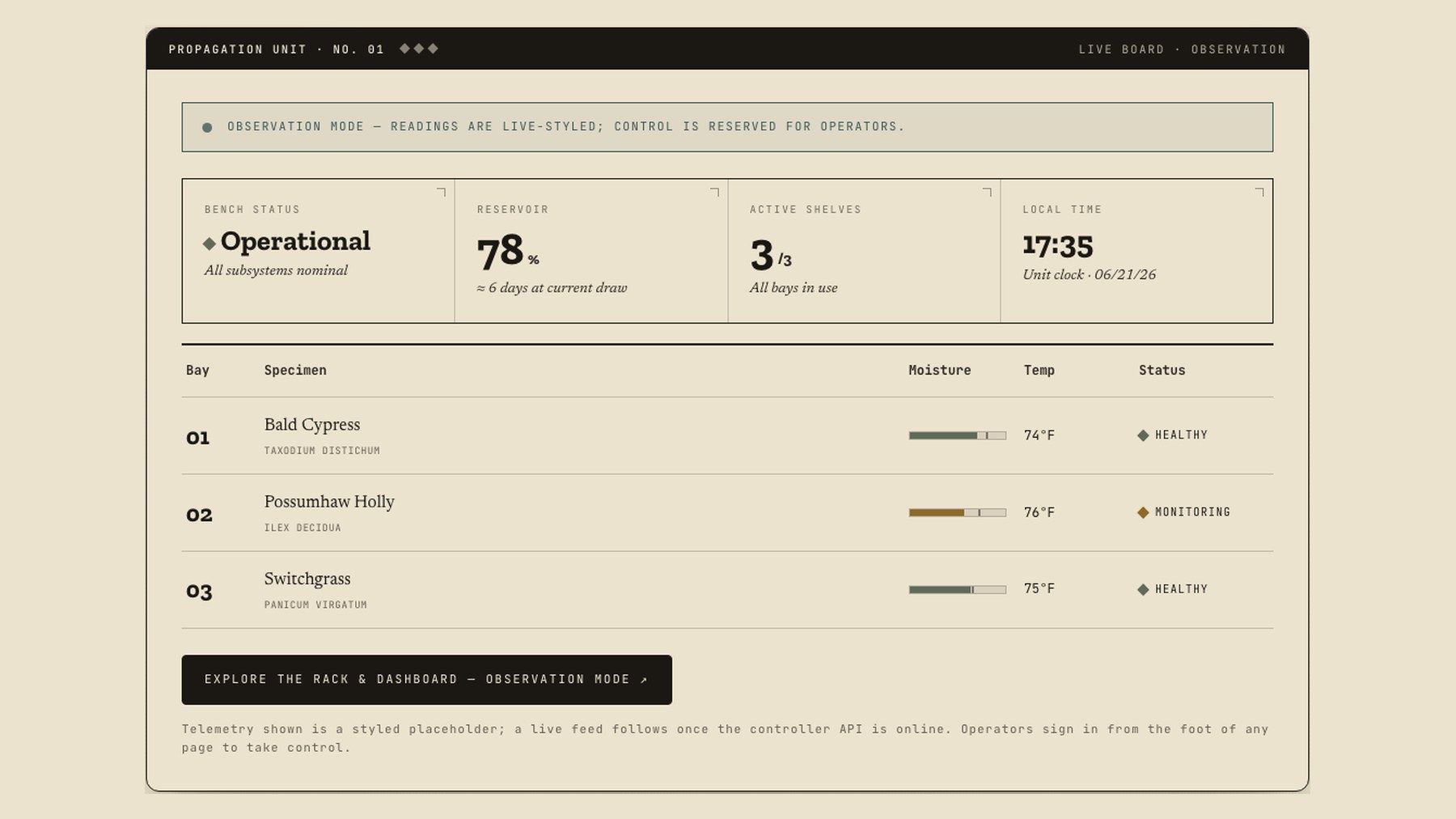 Fig · The unit’s live board, observation mode · telemetry is a styled placeholder until the controller API is online
The first Propagation Unit is a three-shelf bench that raises native restoration stock from seed and cutting with as little daily babysitting as the work allows. It's deliberately small — one rack, off-the-shelf parts, and a controller anyone could rebuild in a weekend. The point was never to build something clever. It was to see how much of a nursery routine you can hand off to a cheap sensor and a valve, so the crew can spend its hours out in the sections instead of standing at a hose.
What it must do
Hold each shelf inside a target moisture band. Run the lights on a per-shelf photoperiod. Move air with a fan. Water a shelf only when it drops below its floor, and never more often than its cooldown allows. And log every reading and every cycle, so a season can be reviewed instead of just remembered.
- Rack — three growing shelves, 01 through 03, on a steel wire frame
- Controller — a single-board Piconium reading moisture, temperature and reservoir level
- Water — 120 L reservoir, diaphragm pump, one solenoid valve per shelf
- Light — full-spectrum bars on a per-shelf schedule
- Air — USB circulation fans on the rack
- Interface — a 5″ Waveshare touchscreen at the rack and a web dashboard
Bill of materials
The full parts list, with the engineering notes, lives in the repo at docs/HARDWARE.md. The short version:
- Compute — a Piconium single-board computer (x86, 4 GB RAM) running Debian
- Display — Waveshare 5″ 800×480 touchscreen (HDMI + USB touch)
- Relays — Numato 8-channel USB relay module
- Serial — an FTDI RS485 adapter (FT232RQ + SP485EN)
- Grow lights — Barina full-spectrum bars, 120 VAC
- Fans — 12 V USB circulation fans
- Pump — a SEAFLO 12 VDC diaphragm pump
- Valves — three U.S. Solid 12 VDC solenoid valves, one per shelf, normally closed (they fail shut on power loss)
- Soil probes — RS485 multi-parameter soil probes (moisture, temperature)
- Reservoir sensor — a submersible hydrostatic level transmitter (RS485)
- Reservoir — a 120 L tank
- Rack — a three-shelf steel wire frame
The interface will be public. Once the controller is running on the bench's own Piconium, the same rack screen and dashboard the crew uses will publish over on Instruments & Infrastructure, read-only. Until then the screens live in the repo.
The code is open source too — the full build, controller and dashboard live at github.com/Short-s-Resort-Field-Station/propagation-controller.